

Onion Soup
S2 E20: Malice Domestic
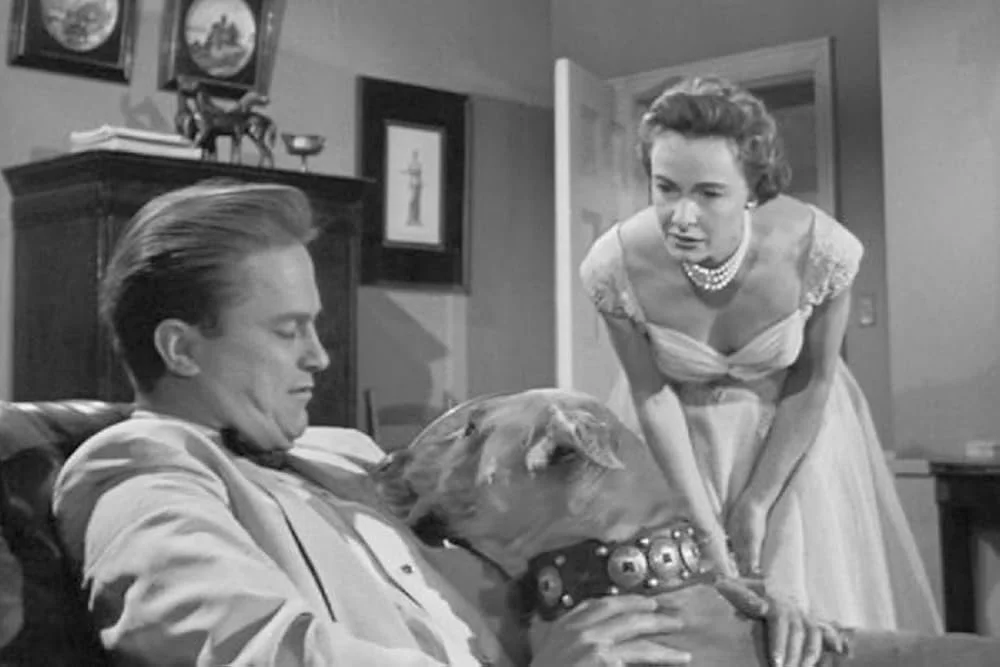
Alfred Hitchcock Presents, NBCUniversal Entertainment, 1955.
There are marriages in which people communicate openly. There are marriages in which people communicate through meaningful silences.
And then there is the marriage at the center of the 1957 Alfred Hitchcock Presents episode “Malice Domestic,” in which everyone keeps smiling, everyone keeps serving everyone else something to eat or drink, and nobody should under any circumstances accept a beverage without first watching exactly where it came from.
Carl and Annette Borden do not, at first, seem particularly doomed.
Annette is affectionate, attentive and encouraging. Carl compliments her ceramics and her cooking. They kiss. They tease each other. They talk about getting away together. She worries when he is sick. He seems genuinely fond of her. If there is trouble in the marriage, it is not announcing itself by slamming doors or shattered glassware.
It is arriving much more politely.
At dinner. With sauce.
Annette is, by all accounts, an excellent cook. Their friend Perry calls her the best cook in town. Carl is very happy to eat what she makes. One dinner includes cold vichyssoise, chicken in wine sauce, broccoli hollandaise and strawberry shortcake, which is a meal that suggests either marital bliss or an extremely confident cardiologist.
Then Carl gets sick. Very sick.
The first explanation is indigestion. Reasonable. The meal was rich. There was hollandaise. There was shortcake. There are limits to what one can reasonably ask of the human digestive system. Then it happens again.
This time, Carl later tells Dr. Wingate that before the attack he ate a bowl of onion soup Annette made for him.
There are foods naturally suited to menace. Onion soup is not one of them. Onion soup is what someone gives you when you have a cold. Onion soup says, I care about you and would like you to be warm.
Which is why an onion soup appearing in a Hitchcock story immediately acquires the energy of a loaded revolver.
The same thing begins happening to every ordinary act of hospitality in the Borden household: A liqueur after dinner, orange juice in the morning, coffee. Nothing is inherently sinister, that is the problem.
“Malice Domestic” is less interested in giving us a household full of obvious threats than in showing how quickly ordinary tenderness can become suspicious once doubt enters the room. Annette does not suddenly transform into a noir villainess. She continues to be caring. She fusses over Carl. She talks about their vacation. She offers him help because that is what she has always done.
And now every offer comes with a tiny invisible question mark.
This is where the episode becomes especially good at its little game. The evidence seems to point somewhere, but the people involved do not behave as neatly as the evidence would like them to. Carl is told something alarming about his illness and refuses to accept the obvious implication. Annette remains loving enough to make that implication feel both plausible and ridiculous at the same time.
Meanwhile, other details start acquiring suspicious little halos of their own.
There is Perry, the complimentary family friend who offers to take Annette to lunch.
There is Lorna, a woman who has recently moved to San Francisco and left her enormous dog Cassandra with the Bordens.
There is Annette’s ceramics work, including a beautiful green glaze with ingredients that suddenly become much more interesting than anyone expected pottery supplies to be.
And there is Cassandra, the dog. Cassandra is also, for a substantial portion of the episode, the person I trust most. Excellent instincts.
Hitchcock introduces the episode as a case in his “court of inhuman relations,” and that turns out to be exactly the right framework. It’s a domestic mystery in the most literal sense: not merely a crime that happens inside a home, but a story in which the materials of home life become the materials of suspense.
The episode keeps taking these harmless little objects, gestures, and characters and placing them under a desk lamp for questioning.
Eventually, it does explain what has been happening.
We will not.
The best way to watch is probably with the same precautions one would take at any elegant midcentury dinner party hosted by Alfred Hitchcock:
Compliment the ceramics.
Be nice to the dog.
Keep track of your cup.
And if someone offers you onion soup, perhaps mention that you’ve already eaten.
Make it! French Onion Soup from Food52