

Potato Chips
S2 E3: The Benefactor
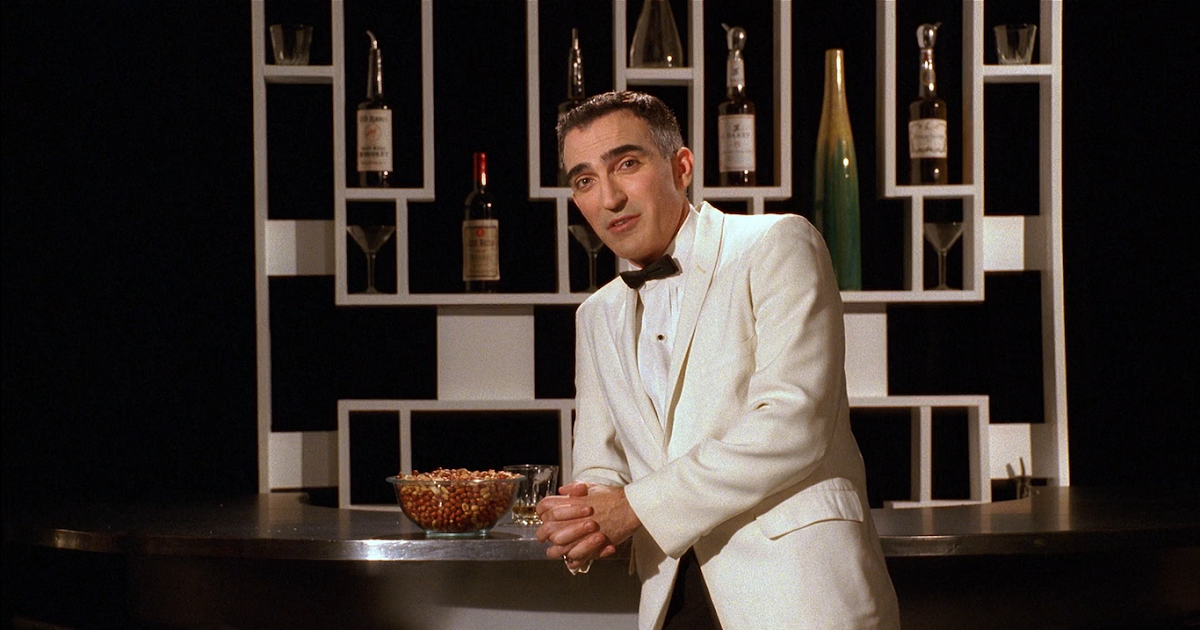
Mad Men, Lionsgate Television, 2007.
The Utz Potato Chips are not the problem. This should be established immediately. They are crisp, present, and sitting on a bar exactly where potato chips are expected to sit.
The problem is Jimmy Barrett.
In “The Benefactor,” Mad Men gives us a celebrity spokesman, a nervous ad agency, an offended client, a resentful media buyer, a wife being drafted into a business dinner, and a bowl of potato chips that behaves more professionally than everyone else in the episode. Jimmy is in the middle of shooting a commercial for Utz when Mr. and Mrs. Schilling, the owners of the company, arrive unexpectedly. This would be fine if Jimmy Barrett were a person who could be trusted around clients. He cannot.
He sees Mrs. Schilling and begins improvising. The Hindenburg comes up. Then a buffalo. Then the phrase “CinemaFat.” It is difficult to imagine a more efficient way to damage an account without setting the actual chip factory on fire.
Don Draper, meanwhile, is not there. He is at a movie. By the time he gets back to Sterling Cooper, the situation has acquired the particular atmosphere of a conference room where several grown men are waiting for one more important grown man to enter and make everything stop being true. Don is informed of the problem, which means the problem now belongs to Don. This is how things work at Sterling Cooper.
“The Benefactor” is full of people trying to determine what, exactly, they are worth to one another. Jimmy is valuable to Utz because he is famous. Utz is valuable to Jimmy because they pay him. Sterling Cooper is valuable because it stands between the two parties in a suit and tries to keep everyone from saying what they really think. When that fails, Don is valuable because he can make unpleasant situations disappear.
Harry Crane is confronting the same question in a more literal form. He accidentally opens Ken Cosgrove’s paycheck and discovers that Ken makes $300 a week while he makes $200. Before opening the envelope, Harry had a salary. After opening it, he has an insult. The money itself has not changed, but now it has context, which is much worse.
Harry responds by doing what any ambitious employee should do after committing accidental mail fraud: he starts looking for leverage. He discovers that CBS has an episode of The Defenders that sponsors are abandoning because it deals with abortion, tries to place a Sterling Cooper client against it, fails, and somehow turns the failure into a promotion. By the end, he is head of a brand-new television department consisting entirely of Harry Crane, with a raise to $225 a week. He has successfully converted resentment into $25 and new business cards.
Don’s version of the same problem is Jimmy Barrett. Bobbie Barrett, Jimmy’s wife and manager, understands immediately that Jimmy does not respond to appeals to decency. He responds to ego. If Don wants an apology, Bobbie explains, Jimmy has to believe Don admires him, that Jimmy knows more than Don does, and that he has a chance with Don’s wife. This is, technically, a business conversation.
That brings Betty into the arrangement. Don asks her to join him at Lutèce for dinner with Jimmy, Bobbie, and the Schillings, although “asks” may be generous. He needs her to charm the room. He needs her to be “shiny and bright.” He needs, as he puts it, “a better half.” There are warmer ways to invite your wife to dinner, but Betty goes, and she is very good at the job she has not technically been hired to do.
At dinner, Jimmy flirts with her, Betty smiles, the Schillings remain polite, and Don keeps the machinery moving. From a distance, it resembles a nice evening in a very expensive restaurant. Up close, it is account repair with tablecloths. Everyone is performing some role for someone else, and the only people who seem fully aware of the transaction are Don and Bobbie.
Even the chips get pulled back into service. When Jimmy finally apologizes to the Schillings, he tells them he would rather eat their potato chips than anything in the restaurant. The product survives. The account survives. The potato chips, once again, have behaved beautifully.
Betty, however, experiences the evening differently. On the drive home, she cries because she is happy. She tells Don that when she said she wanted to be part of his life, this is what she meant. “We make a great team.”
That’s the unfortunate cruelty at the center of the episode. Betty believes she has finally been invited into Don’s world, when in fact she has been deployed inside it. She does not know how much of the evening was negotiation, leverage, and damage control. She only knows that Don needed her, and she came through.
Everyone in the episode wants to know what they are worth. Harry finds out there is a number. Jimmy knows there is a contract. Bobbie knows there is leverage. Don knows people can be managed. Betty thinks usefulness means intimacy.
And somewhere in the middle, a bowl of Utz Potato Chips sits quietly on a bar, crisp, reliable, and oh-so professional.
Better than nuts!