

S19 E11: Gap Girls at the Foodcourt
Saturday Night Live, NBCUniversal, 1975.
There are few places more spiritually honest than a mall food court in 1994. The lighting is fluorescent. The trays are plastic. And in the middle of it all sit the Gap Girls, on break but never truly resting, orbiting each other in a tight formation of denim, gossip, and minimum wage contempt.
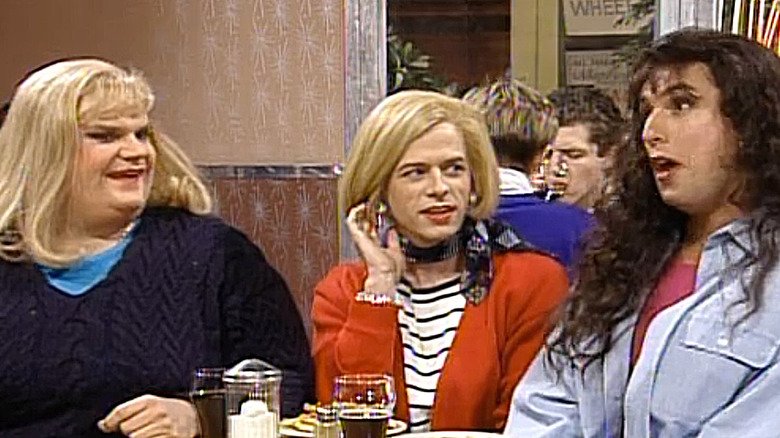
In the February 1994 episode of Saturday Night Live, hosted by Sara Gilbert, “Gap Girls at the Foodcourt” captures a very specific ecosystem: three retail employees who work at The Gap but treat employment as more of a loose suggestion. Lucy (Adam Sandler), Kristy (David Spade), and their boss Cindy (Chris Farley) have the energy of people who have been folding sweaters for six hours and are now metabolizing only fries and unresolved boy drama.
They do not take their job seriously. They barely take customers seriously. What they take seriously are: boys, rivalries, Court TV, and French fries.
The sketch begins mid-chew. Kristy claims she has “Carpet Tunnel Syndrome” from folding sweaters. Lucy diagnoses it as “Cheeseball Syndrome.” They laugh like feral cats. Cindy arrives with a joke about Michael Jackson and immediately messes up the punchline. The girls correct her with the sharpness of people who have been watching too much tabloid television and not enough reality.
This is the rhythm of the sketch: petty, affectionate cruelty delivered at mall-volume.
Then there are the fries.
The fries are the emotional centerpiece. They sit in the middle of the table, golden and communal, an edible treaty between girls who insult each other constantly but still share salt. Lucy grabs a handful and announces her love. Cindy asks for some. Lucy hesitates. There is, briefly, the suggestion of calorie politics.
And then it happens.
“I thought you were trying to lose weight?”
Chris Farley’s voice, previously pitched high in a Valley-girl register, drops into something cavernous and ancient.
“LAY OFF ME, I’M STARVING!”
It is not simply yelling. It is a demonic possession by hunger itself. It is the sound of every retail worker who has skipped lunch, every person who has ever tried to diet while sitting directly in front of fries, every human body refusing to be shamed in a food court.
The moment detonates the table. Sandler and Spade visibly fight laughter. The audience erupts. And for one perfect second, the sketch stops being about The Gap and becomes about appetite, the kind you can’t file down with mall-friendly self-improvement.
Around the fries, the larger plot continues. Their rivals from the Donut Hut arrive, led by Tracy’s orbiting emissaries, ready to escalate the Cold War of fast-casual employment. There are insults about boyfriends, about weight, about minimum wage. Kristy defends an obviously terrible boyfriend. There is talk of punched necks and redial trickery and Cancers as astrological excuses for assault.
The girls chant “O.T.R.” with the solemnity of a cult.
What makes the Gap Girls sketch endure isn’t just Farley’s vocal drop, though that’s the clip everyone remembers. It’s the way the sketch captures the theater of young adulthood in a mall: the way friendship is loud and mean and deeply loyal all at once. The way French fries can be both communal and territorial. The way minimum wage jobs feel like the center of the universe until you clock out.
Cindy declares “diet starts Monday,” as if Monday is a real place that will fix everything. It never is. But in the food court, under fluorescent lighting, surrounded by fries and rivalry and deeply flawed men named Paul, Monday feels negotiable.
The Gap Girls don’t grow. They don’t learn. They don’t fold the sweaters any faster. Four days later, they’re wearing the same outfits. The same insults. The same fries.
Lay off. They’re starving.