

Popplers
S2 E18: The Problem with Popplers
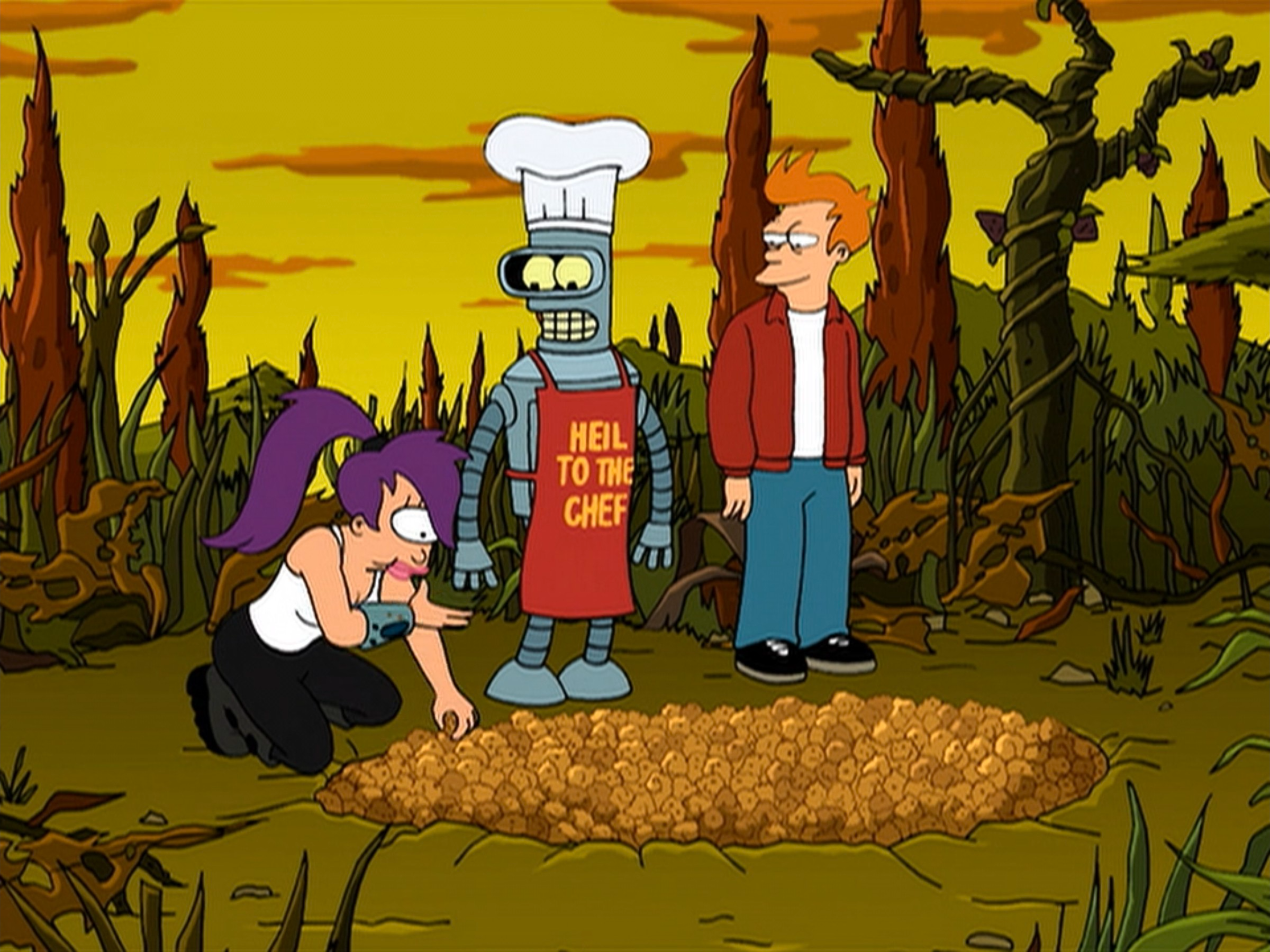
Futurama, The Walt Disney Company, 1999.
Humankind has met many foods with an admirable combination of curiosity, greed, and catastrophic moral laziness. The oyster. The hot dog. Anything sold in a novelty bucket.
But few foods have risen so quickly from “mysterious roadside protein” to “planetwide ethical crisis” as the Poppler, a snack so irresistibly delicious that no one involved pauses for even a moment to ask the two questions that should accompany any newly discovered edible species: What is this? and How upset will its parents be?
This is the central achievement of Futurama’s “The Problem with Popplers,” an episode that begins, as so many great food stories do, with a hungry group of idiots rummaging around on an unfamiliar planet and deciding that the strange shrimp-like creatures wriggling in a ditch are probably dinner. Leela scans them, determines they are not poisonous, and takes the first bite. The verdict is immediate and deeply damning. They are incredible. Bender, seeing destiny in a chestful of fried larvae, does what any entrepreneur with no conscience and a sandwich-board view of capitalism would do: he starts thinking about scale.
And scale arrives fast. One minute the crew is cramming Popplers into the ship for personal use, and the next they are selling them on the street, then wholesaling them to Fishy Joe, who immediately grasps that the best way to profit from a delicious mystery is to commercialize it before anyone can identify its species, rights, or social structure. This is the genius of the episode: it understands that the trajectory from “What are these?” to “Over 3.8 x 10^10 served” is not a slippery slope but a straight, well-lit highway. Nobody asks where Popplers come from because nobody wants the answer to interfere with the dipping sauces.
The Poppler itself is one of the great fake foods in animated television because it sits at the exact crossroads of adorable and edible. It is small enough to be sold by the dozen, cute enough to trigger unease the second it opens its eyes, and delicious enough that even the audience understands the temptation. This is not a bleak health-food allegory about a joyless pellet no one would ever eat voluntarily. Popplers look fun. They sound crispy. They arrive in paper tubs. They go with honey mustard. In other words, the episode does not let the viewer off easily. It does not present evil in the form of gray paste. It presents evil as a highly snackable product with excellent branding and broad market appeal.
And then, because the universe occasionally takes offense at industrial-scale appetite, one of the Popplers wakes up and calls Leela “mama.”
This is where the episode swerves from food satire into moral farce of the highest order. Leela, who began the crisis by eating the first Poppler on the nursery planet, is now the only person willing to treat the matter as anything more than an inconvenient public relations wrinkle. The rest of the world responds to the revelation with the exact seriousness one would expect from a civilization that turns every ethical issue into a panel discussion, a coupon promotion, or both. Fishy Joe argues that intelligence is not a meaningful line because people will eat anything that turns a profit. The protesters of M.E.A.T., a name so stupid it loops around to being perfect, are mostly right but too ridiculous to help. Fry tries to take a principled stand in the vague, soft-headed manner that only Fry can, while Bender commits himself fully to the oldest solution in commerce: if demand weakens, increase advertising and confuse the messaging.
There is a lot to admire in how mercilessly the episode treats everyone. Fishy Joe is a capitalist ghoul, obviously, but he is also only a slightly more honest version of everyone else eating Popplers by the bucket. The protesters are ethically correct but socially unbearable. Leela is morally awakened but also deeply implicated, because she was the first to eat one and the first to decide the things were safe based on a wrist gadget and pure hunger. Even the debate over intelligence proves hilariously unstable. Humans insist that intelligence is the line, right up until that line threatens something tasty. Then suddenly everyone becomes a philosopher of convenience. Dolphins? Depends on the dolphin. Popplers? Let’s not rush to judgment. Orangutans dressed as Leela? Close enough for television.
And then, in one of the episode’s best turns, the consequences arrive not as guilt or regulation but as Lrrr. The Omicronians descend upon Earth to announce that Popplers are their children, harvested from one of their nursery planets and devoured by the billions. It is one of those wonderful Futurama escalations in which an already absurd premise becomes, very quickly, an interplanetary diplomatic nightmare. The demand for justice is mathematically impossible, monstrously disproportionate, and still difficult to argue with on its own terms. Humans have eaten their babies by the billion. The Omicronians, naturally, would like to return the favor. It is only because there are fewer humans than consumed Popplers, and because Lrrr gets full on nuts during negotiations, that Earth is spared total annihilation and Leela alone is selected as the ceremonial entrée.
The sacrificial spectacle at Madison Cube Garden is the episode at its most beautifully stupid. Zapp Brannigan, whose plans always feel as though they were generated by a machine trained exclusively on cologne ads and head injuries, attempts to fool the Omicronians by substituting a female orangutan dressed as Leela. This almost works, not because the plan is good, but because the universe of Futurama is kind enough to reward bad ideas if they are sufficiently theatrical. Naturally, it fails when Free Waterfall Junior, hippie menace and professional irritant, rushes in to defend one of Earth’s “most precious creatures.” This is an important distinction for him. Billions of alien babies may have been battered and dipped with sauce, but heaven forbid an orangutan in a ponytail be inconvenienced.
In the end, the episode solves its ethical crisis not through law, reason, or species-wide repentance, but through a baby Poppler named Jrrr, who has imprinted on Leela and chooses, in a fit of impossible grace, to argue against revenge. It is a small, sentimental intervention in an otherwise gloriously cynical episode, and it works because Futurama understands that tenderness lands hardest after everyone has spent twenty minutes proving themselves morally grotesque. Jrrr persuades the Omicronians to spare Leela, Lrrr eats the hippie instead, and then immediately gets so chemically overwhelmed by the contents of Free Waterfall Junior’s bloodstream that he stumbles away in a narcotic revelation about his own hands.
The final joke is, of course, the one that makes the whole episode sing. After surviving a planetary ethics disaster centered on the eating of intelligent creatures, the Planet Express crew gathers for a celebratory meal and simply redraws the line. Veal is fine. Suckling pig is fine. Dolphin is apparently fine as long as this particular dolphin was bad with money. The lesson has not been learned so much as administratively narrowed. No one has become better. They have merely become more selective. Which is, to the episode’s credit, probably the most accurate possible ending to a story about food, morality, and convenience.
What makes “The Problem with Popplers” so enduring is that it never pretends appetite is a small thing. Appetite is enormous. Appetite builds supply chains. Appetite writes jingles. Appetite invents slogans, ignores warnings, monetizes ambiguity, and only grows more determined when handed a bucket and a dipping sauce. The Poppler is funny because it is absurd, but also because it is instantly recognizable. It is every food people love just a little too much to inspect closely. Every menu item whose origin story no one really wants at the table. Every crispy, snackable object that becomes, the second it is profitable, someone else’s problem.
And if the episode has a thesis, it may simply be this: people will eat almost anything, provided it is delicious,well-marketed, and briefly absolved by a television debate.
Preferably with honey mustard.
Make it! Popplers from The Starving Chef