
Sugar Bombs
S1 E1: The End
Fallout, 2024.
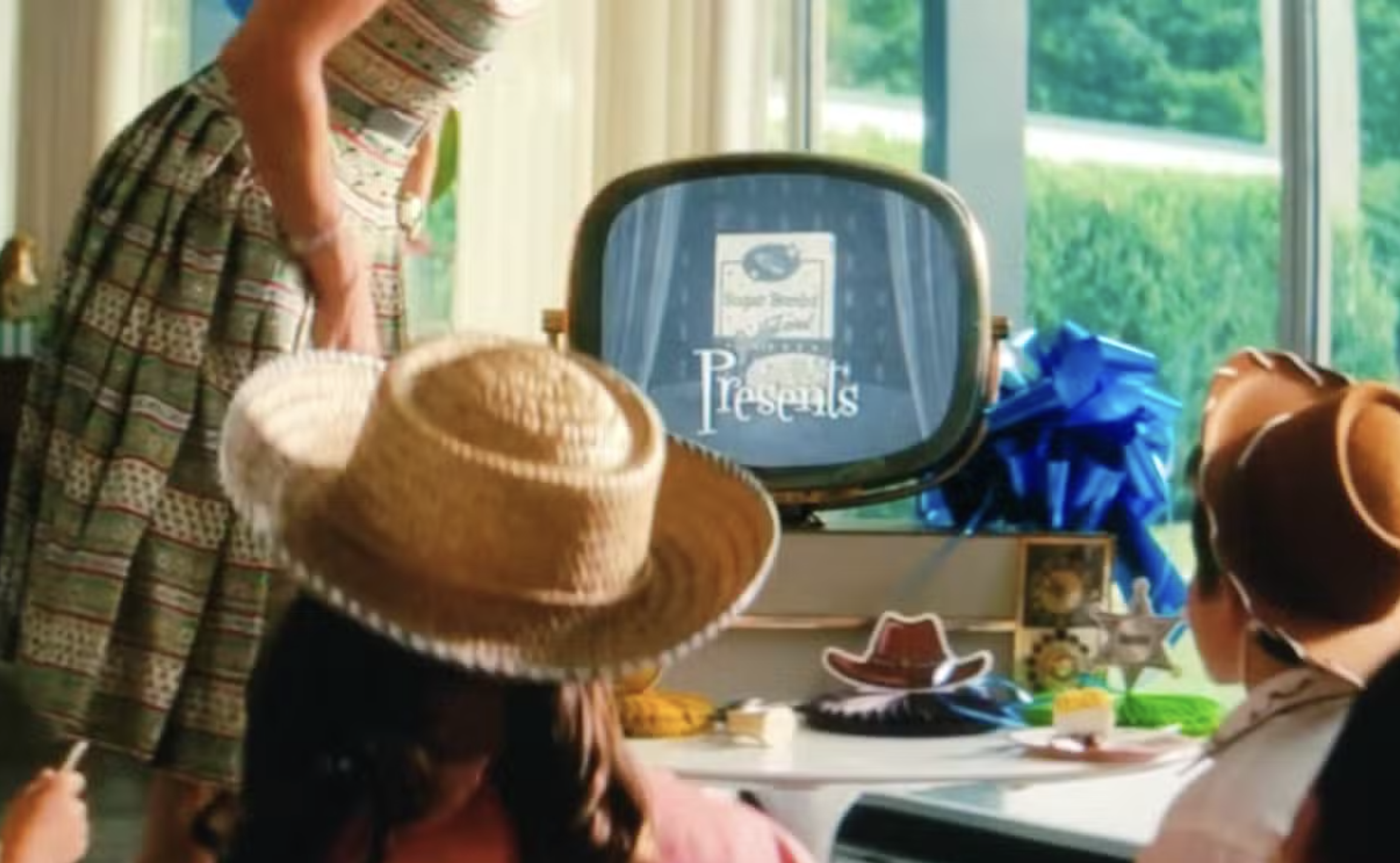
Nearly the first thing Fallout does, before it lets you meet anyone you’ll come to fear, root for, or mourn, is show you a television.
Not a smart TV. Not a tasteful TV. A big, boxy monument to American confidence, flickering in a living room where a birthday party is still happening, where the cake has been cut, where children are still high on frosting and the thrill of having their photo taken with a famous man on a horse.
The man is Cooper Howard, a movie-star cowboy reduced (by alimony, by time, by the gentle cruelty of capitalism) to smiling at children and performing a thumbs-up he no longer believes in. The kids come back inside after the photos, back from the sun and the staged cheer, and they do what kids do when the adults are distracted and the sugar is peaking: they turn on the TV.
Mom, trying to keep the day in the safe lane, flips the channel to something “friendly.” Something that won’t stain the walls with panic. Something that won’t bring the grown-up dread into the room where the candles are still smoking and the plates are still stacked with crumbs.
But the news bleeds through anyway, because it always does. There are whispers of nuclear bombs, negotiations collapsing, the world teetering with that particular, sterile phrasing that governments use when they’re trying not to say we are about to end everything.
And then, like a brightly colored bandage slapped over an arterial wound,t he TV delivers what it was built to deliver:
A Sugar Bombs cereal commercial.
Sugar Bombs presents Grognak the Barbarian and the Ruby Ruins, a cheerful little blast of animated mayhem, kids laughing, the sound of marketing pretending it can outshout the apocalypse. The commercial is a perfect micro-dose of the world that’s about to vanish: loud, absurd, and sweet enough to make you forget you’re hungry for something real.
It’s also the cruelest possible timing, which is exactly what Fallout excels at. Here is this cereal, this smiling cartoon violence, this breakfast product named like a warning siren, playing at the exact moment the adults are trying to keep things normal. It’s the last bright wrapper on the shelf before the store burns down. It’s the joke the universe tells right before it pulls the lever.
Cooper, meanwhile, is trying to stay inside the birthday. He tries to keep the dread from leaking into his daughter’s face. He’s a man who has learned to perform happiness for a living, and now he’s performing it for survival.
But his daughter, smart, small, watching him closely, asks about the thumbs-up. Why he wouldn’t do it. Cooper gives her the grown-up answer packaged as a kid story: the Marines taught him you hold your thumb up to the mushroom cloud. If the cloud is smaller than your thumb, you run. If it’s bigger… they told you not to bother.
A bedtime story for the end times. A father trying to translate terror into a rule a child can hold in her hands.
And then the episode proves it wasn’t a metaphor. It wasn’t mood-setting. It wasn’t retro flavor.
Smoke appears. A rumble. The sound of doors, of people outside pleading, of a world that suddenly remembers it has bodies and those bodies are fragile. The party dissolves into instinct. Cooper grabs his daughter. There is running. There is the unbearable clarity of realizing you’re not in a story you can edit.
Two hundred and nineteen years later, the show snaps to a different kind of television.
We meet Lucy MacLean, bright-eyed and meticulously self-assessed, narrating her own worth in the language of community contribution and intact reproductive organs. In Vault 33, civilization is a curated exhibit. Smiles are part of the architecture. Romance is an organized trade agreement. Everyone is polite in the way people get when the door to the outside world is both sacred and terrifying.
Lucy is chosen for an arranged marriage with a man from Vault 32. The wedding is cheerful, hopeful, and soaked in the kind of optimism that only exists when you’ve never had to test it against reality. There are speeches about civilization and candles in the dark. There is dancing. There is the soft glow of a community congratulating itself for surviving.
And then the visitors from Vault 32 reveal themselves as raiders wearing borrowed faces. Hope turns into screaming. The vault becomes a slaughterhouse with better lighting. Lucy’s father, Overseer Hank MacLean, is taken. The rules that have held her life together, don’t open the doors, don’t go outside, don’t believe in the surface, suddenly look like what they always were: protection, yes, but also denial.
Lucy breaks the most sacred regulation and goes topside anyway, because love can do that: it can make you step past the guardrails and into the open air with nothing but a gun you’re not good with and a promise you made to yourself in a moment of panic.
Elsewhere, the world is building its other pieces. The Brotherhood of Steel promotes Maximus into a role that is half honor and half punishment, and sends him into the Wilds to hunt down an Enclave target. The surface is introduced as a place where violence is less a problem to be solved than a weather system, constant, swirling, indifferent.
And finally, in the dirt, in the harsh light, we find the other half of Cooper Howard’s story: the famous cowboy reanimated into something else. A Ghoul, dug up and measured for usefulness by men who treat bodies like tools and death like a contract clause. They offer him “one last job,” which is always how men like that talk right before they get themselves killed.
Cooper (the Ghoul) declines the group plan, kills them instead, and rides after the bounty alone. Not because he’s noble. Not because he’s cruel. Because he’s been around long enough to know how these stories go. Because he does it “for the love of the game,” which is another way of saying: when the world ends, you don’t become your best self. You become your truest one.
The pilot of Fallout is ultimately about packaging, about how we wrap terror in entertainment and call it normal. It starts with a birthday party and ends with a wasteland. It starts with a mother changing the channel to something “friendly” and ends with the truth that there is no friendly channel, not when the bombs are already in the air.
And threaded through it all is that first flickering image: the Sugar Bombs commercial, cartoon laughter in a living room, playing right when the world is about to stop pretending.
Because that’s the joke of it, isn’t it?
Right before everything burns, the TV tries to sell you breakfast.
Make it! Sugar Bombs from Nerds Kitchen